Showing posts with label book reviews. Show all posts

Tuesday, March 14, 2023

Book Recommendations for CS People

tl;dr Book recommendations:

Overnight Code was recommended to me after I recommended Code Girls on Facebook. Overnight Code is a truly inspiring story of a woman with two strikes against her (female and Black) whose hard work, determination, and talents helped her do some revolutionary work in naval engineering and integrating hardware/software systems.

Debugging code is arguably a lot harder than writing new code. Raye Montague was amazing at debugging code and integrating disparate systems. But also a good person who helped mentor and advance others. She was given tasks that others had said were impossible to complete. Talent and hard work (Raye had a lot of both) allowed her to accomplish beyond expectations.

There is a lot of good career and life advice woven into this story as well. Advice for everyone. I could have benefited from this book early in my career.

"Code Girls: The Untold Story of the American Women Code Breakers of World War II"  was recommended by several people in a Facebook group dealing with a Kindle Challenge that Amazon is running. The idea about code breaking sparked my interest right away. This book was more than just that though.

There were plenty of insights into code breaking but the look into the lives of these amazing women was the highlight. It was a different time and women would not as respected as they should have been. Yet, these women put their considerable talents into working for the war effort and their country.

Code breaking is a fascinating subject in itself of course. I enjoyed reading about the “bombe” machines, how they were created and used. I also found the difference that code breaking made in the conduct of the war (World War II) to be interesting. This is not the sort of thing many history courses cover.

It’s easy to label these books as books for Women’s History Month or the Raye Montague book as being for Black History Month but that would be a mistake. These are books for all year long. I recommend them to anyone interested in the progression of computing in society. Code Girls is a great read for cybersecurity or cryptography students. Overnight Code is a powerful read for anyone not just computer science people. It is just that inspiring.

Monday, September 20, 2021

Book Review–System Error: Where Big Tech Went Wrong and How We Can Reboot

System Error: Where Big Tech Went Wrong and How We Can Reboot is what you get when a top philosopher, a top political scientist, and a top computer scientist get together to think deeply about technology and society and write a book.  It’s not a book for just one group. It’s not a dry textbook or academic paper but a clearly written explanation of the issues. It’s a book for everyone.

The book talks a lot about both artificial intelligence and social computing which are more connected to each other than may be obvious at times. The social and political impacts of these topics and others are covered in a clear and understandable way without hyperbola, scaremongering, or blatant cheerleading. This is one more thing that makes it stand out from many other books on these topics.

Yes, there are parts that are scary. Yes, there are parts that are optimistic. All in all though it is as fair and open minded a book as one can get. The book askes questions that have to be asked. There is enough data and sets of facts to give one a lot to think about. In fact, I found several times that I had to put the book down to think about what I had read. It’s that sort of book.

Were I teaching Advanced Placement Computer Science today, especially Principles but also APCS A, I would assign reading from it and have class discussions. If I could not get a class set I would at least have some copies in the library put on reserve. But I’d really like my students to read it all.

This is a book that should be on some required reading lists. Computer scientists really do need to think about the “should we do this” question as much as the “can we do this” question. This is the book to start thinking that way. But policymakers need this books as well. So do business people. So give it to the polysci and business majors you know.  A lot of social scientists should read it as well – sociology, psychology, social work. Probably more. It will help one understand what people are dealing with in today’s world.

Technology is impacting society, and our democracy, in many ways. Some are obvious and some are not. If we want to have a civil society we need to think deeply about the impact of technology on individuals and organizations This book is a great way to start.

Tuesday, September 15, 2020

Why Computer Science Teachers Should Read Books

Since I retired I have been reading more computer science related books. You may have read my book reviews on Humble Pi, Weapons of Math Destruction, or Computer Science in K-12. More and more I realize that I missed out on a lot of good ideas and information. Each of those books has given me ideas that I wish I had thought of a long time ago.

Currently, I am reading Nine Algorithms That Changed the Future: The Ingenious Ideas That Drive Today's Computers. I haven’t gotten very far yet but the book has covered indexing of web pages, PageRank, and public key encryption so far. I’ve started the chapter on error detection. Pattern recognition, data compression, data bases, and more are yet to come. I’m really looking forward to data compression. Teaching AP CS Principles has built up an interest that I didn’t have before.

The indexing chapter is one I had read long ago. Many years ago I experimented with indexing. I wrote some code that indexed the Bible for me. The program was more general purpose than that but the Bible seemed like a good challenge. The program used a list of words and a text file of a book as input. It output a markup language file that worked with a product called VAX Document. VAX Document read the markup language, called SDML, and formatted a document including an index. I wish I still had the code so I could adapt it for some other backend processors. Sigh.

In any case, the idea of creating and assigning indexing projects has some appeal for me. I can see this being interesting for students especially in the context of understanding search engines and more involved search queries.

Other chapters include a lot of information that would be helpful in understanding and explaining various important concepts. And maybe inspire still more programming projects!  So I do recommend this book to AP CS Principles teachers.

PS: More of my book reviews at http://blog.acthompson.net/search/label/book%20reviews

Saturday, August 15, 2020

Book Review: Humble Pi

Recently, I asked my Facebook friends for recommendations for non-fiction books that would not get me depressed. Several people recommended Humble Pi: When Math Goes Wrong in the Real World so I bought a copy. I’m glad I did.

The book presents some interesting case studies in math done wrong. From people confusing units of measure (pounds and kilograms for example)  to engineers changing one variable in an equation and assuming the answer doesn’t change and many more. As you might expect there are a lot of examples where computers play a role.

There are examples of problems caused by variable type mismatches, binary overflows, and people just misinterpreting the results. You’ll get any number of examples you can use with students. A valuable book to teachers of computer science, physics, and mathematics for sure.

The book is written in an easy to read and often humorous fashion. It’s an enjoyable read even if you are “not a math person.” I bought the Kindle edition but I am wishing I hard bought a hardcopy edition to keep on my bookshelf. I’ll be back looking at this one.

Saturday, July 18, 2020

Book Review: Weapons of Math Destruction

Weapons of Math Destruction has been out for a couple of years now and it is one of those books that a lot of people reference. I finally got around to reading my copy this week.  For those of you who are not familiar with it, the book talks about algorithms involving huge amounts of data and how they are used and misused.These WMD are involved in increasing parts of our lives from teacher evaluations, to credit scores, to policing, to getting hired for a job. Companies make assumptions that the algorithms are fair, impartial, and that they get the results they are advertised to provide. Often all of those assumptions are wrong.

In some ways I think the point could have been made with one or two chapters but providing a multitude of examples is definitely informative and convincing. The book is more than a little scary but I think that is the point. We should be concerned.

Those of us involved in computing, perhaps especially those of us teaching computing, need an eye opening book like this. It can help us do better and perhaps avoid some of the unintended consequences that this book so clearly outlines.

I’d love to assign this book as required reading to students. I could probably get away with that at the university level but high school students are both reading adverse and already loaded with a lot of reading. I think what I would do at the high school level would be to place a couple of copies on course reserve and assign specific chapters to individual students to read. I’d have them submit both an oral and a written report of their chapter. Some group discussions would also be a plus. This is a natural for an AP CS Principles course but I think it would fit in elsewhere as well.

We need people in computing who can look at technology and think about unintended consequences and, perhaps more importantly, ask what are the impacts on society of what we are thinking about doing? Is it all just about money and the bottom line or are we actually making people’s lives better?

Wednesday, July 01, 2020

Book Review: Computer Science in K-12

Full disclosure: I haven’t read all of “Computer Science for K-12” edited and compiled by Shuchi Grover yet but a couple of chapters was enough to convince me I should recommend it to other computer science teachers. The books has chapters written by a veritable who’s who of computer science educators. (See the table of contents listed below) I’ve heard many of them speak, read much of their published works, and met more than a few of them. I knew from the author list that it would be worth having.

I have been jumping around a bit but for me the chapter on Naïve Conceptions of Novice Programmers alone was worth the price of the book.  I have no doubt that I am going to learn a bunch reading the rest of it. The chapter or chapters you read that makes the book worth the price may vary but I suspect you’ll find several such. If you are looking to improve HOW you teach CS you should get this book.

It is available with black and white illustrations and diagrams and color versions. I bought the black and white version but wish I had spent a few extra dollars for the color. It's available from Amazon and Barnes & Noble

The table of contents is below from the Amazon page.

  1. Foreword (Inventing Computing Education in Schools) by Mark Guzdial
  2. Algorithms (Shuchi Grover)
  3. Before You Program, Plan! (Phil Bagge, Shuchi Grover)
  4. Creative Coding (Miles Berry)
  5. Data Structures (Baker Franke, Richard Kick)
  6. Events (Jennifer Rosato, David Wolber)
  7. Feedback Through Formative Check-Ins (Shuchi Grover, Vicky Sedgwick, Kelly Powers)
  8. Guided Exploration Through Unplugged Activities (Paul Curzon, Shuchi Grover)
  9. Hard Fun With Hands-on Constructionist Project-Based Learning (Deborah Fields, Yasmin Kafai)
  10. Integrating Programming Into Other Subjects (Shuchi Grover, Aman Yadav)
  11. JavaScript, Python, Scratch, or Something Else? Navigating the Bustling World of Introductory Programming Languages (David Weintrop, Shuchi Grover)
  12. Knowledge, Skills, Attitudes, and Beliefs | Learning Goals for IntroductoryProgramming (Rebecca Vivian, Shuchi Grover, Katrina Falkner)
  13. Learner-Centered and Culturally Responsive Pedagogy (Tia C. Madkins, Jakita O. Thomas,Jessica Solyom, Joanna Goode, Frieda McAlear)
  14. Modularity With Methods and Functions (Mike Zamansky, Jens Monig, Jonalf Dyrland-Weaver)
  15. Naïve Conceptions of Novice Programmers (Juha Sorva)
  16. Operators and Expressions (Matthias Hauswirth, Shuchi Grover)
  17. Pair Collaboration and Pair Programming (Shannon Campe, Jill Denner)
  18. Questioning and Inquiry (Shuchi Grover, Steven Floyd)
  19. Repetition and Recursion (Dan Garcia, Joshua Paley)
  20. Selecting Pathways With Conditionals (Shuchi Grover)
  21. Testing and Debugging (Kathryn Rich, Carla Strickland)
  22. Universal Design for Learning: Reaching All Students (Maya Israel, Todd Lash)
  23. Variables (Shuchi Grover)
  24. Worked Examples and Other Scaffolding Strategies (Jane Waite, Shuchi Grover)
  25. X-ing boundaries With Physical Computing (Sue Sentance, Katharine Childs)
  26. Yay, My Program Works! Beyond Working Code ... Good Habits of Programming (Shuchi Grover)
  27. Zestful Learning (Bryan Twarek)

Tuesday, September 17, 2019

Book Review: "Tools and Weapons"

"Tools and Weapons" by Brad Smith and Carol Ann Browne is a look at some important computing issues through a Microsoft lens. It is a pretty revealing look as the authors write seriously about the thinking behind Microsoft’s dealing with issues like the Snowden leaks, suits against the government about over reaching subpoenas, protection of users data, transparency, cyber security, and more.

I really like this line from the introduction "When your technology changes the world, you have a responsibility to help address the world you helped create."

There were several threads moving through the book. One was the need for building guiding principles for looking at technology and its uses. An other was the need for diversity among people developing technology and the guiding principles. There is frank talk about embedded bias in algorithms and how diversity is essential to fixing that problem. Responsibility for what technology does is another key thread. Without using these words, the book suggests that “should we” is as important if not more so than “can we.”

The chapters on Artificial Intelligence and facial recognition are the best look at the pros and cons I have read so far. Many people seem to have a doomsday view of AI but Smith and Browne have a more nuanced look; one that is not apocalyptic but more practical and near term. There is a lot to think about in these chapters but the picture painted is more about how we need to think about issues going forward than that we should either panic or be unconcerned.

I found the chapter on China very interesting. It was clearly written carefully to outline cultural and political differences without appearing to attack anyone. I might have preferred a stronger stance but I’m not the president of a global company.

One clear takeaway for me is that today’s Microsoft is not the same Microsoft as it was under Ballmer or Gates. Satya Nadella is a different sort of leader altogether and ethics and principles of a company are set at the top. Where Gates was naïve in some ways and Ballmer was focused on the bottom line Nadella, while not losing sight of the bottom line and still naïve in some ways (remember his gaffs about women getting ahead) looks at things differently, listens better, and is interested in the better good.

His decision to release Windows XP patches for the WannaCry virus for free is one I have to wonder if Ballmer would have made the same way. Maybe he would have but that I have to wonder is telling.

The book is not a difficult read. The language is non technical and technology is explained in layman’s terms. That is not to say that the book is only for non-technical people. I think technical people should read it. So should policy makers in both government and the private sector. It would make a great supplemental reading for an ethics course, especially for an ethics course for technical people.

One last interesting thought from the book. No one graduates from a US military academy without taking an ethics course but many people graduate with technical degrees without taking an ethics course. Maybe that should change.

Wednesday, August 07, 2019

Book Review: The Creativity Code

I’ve been reading a lot about Artificial Intelligence (AI) this year. Several of them have been pretty scary. It was recommended that I take a look at “The Creativity Code: Art and Innovation in the Age of AI” by Marcus DuSautoy. It was a good recommendation. This book is different from the others I have read. Or tried to read. It’s focus is not on business or about intelligent weapons. The focused as the title suggests is on creativity.

The book discusses how computers, or rather AI software, is creating art, music, and new ideas in mathematics. The author is a renowned  mathematician so the sections on using AI in math, developing proofs for example are especially well done. One unexpected benefit of the book for me was a new appreciation for what mathematicians actually do and why they find some year joy in the field.

The author shares some concerns about how AI might make mathematicians like himself obsolete. In the long run though he sees a place for human creativity in the world. AI routines are still being trained by people. They do go beyond what they are specifically trained but have to start with that training. Well, usually anyway. Will that change? Let’s just say that there are still a lot of unknowns. AI has moved in ways we haven’t expected already so there is that.

If you are interested in learning about AI in art (computers creating works in the style of famous artists for example, music (using existing styles or creating new ones), writing (fiction or non-fiction), mathematics, and several other fields we don’t usually associate with AI this is a good book for you.

It’s an interesting and usually easy read (I confess some of the math was a little deep for me). It an in interesting look at AI. Recommended.

Thursday, April 26, 2018

Computer Science K-12: Imagining the possibilities!

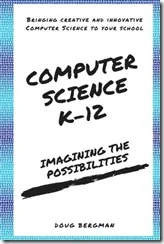
My friend Doug Bergman has a new book out called Computer Science K-12: Imagining the possibilities!

I reviewed drafts of the book while it was being written and I can tell you there is a lot of good stuff in it.


Doug BookFor teachers new to Computer Science who have been charged with starting a new class at your school, and just don't know where to start. I'll walk you through what you need to be considering such as which technologies, what type of curriculum, student recruitment, professional development, connecting with other CS teachers, and pedagogy.


For school leaders, board members, and decision makers who need to know what Computer Science really is, what it looks like in the real world, and what it can look like in education-- this book will guide you through many of those early questions as you consider if, how, and where Computer Science fits in your schools: What are the attributes of successful CS teachers? Where can I hire teachers? Do I need "experts" in CS? How do I evaluate a project-based class? Standards? Training for new teachers? What successful programs can I look at for ideas?


For those experienced CS teachers who are just not seeing the energy and engagement in your classes, this book will be a wealth of innovative ideas and strategies to help you engage differently with your students.
Technology today is interactive, engaging, and dynamic; Computer Science classes should have that same feel. You'll see how to create a student-centered classroom where students lead their own learning.