Wednesday, April 04, 2018

Phillips Academy Capture the Flag 2018

Those of you with interests in working on cybersecurity with your high school students this Capture the Flag event will find this to be of interest.


PACTF is back! PACTF 2018 begins Monday, April 16. Like last year, PACTF will work around your schedule and have a challenge for you, whether you’re a seasoned CTF veteran or just beginning. This year, we are proud to offer over $20,000 worth of prizes to the top 150 teams.

Short for Phillips Academy Capture the Flag, PACTF is a computer science and cybersecurity competition for high-schoolers. PACTF is brought to you by Amazon, DigitalOcean, and JPMorgan.

There will be two week-long rounds: from April 16 to April 23, and from April 23rd to April 30, 2017. During each round, you can pick any 48-hour span to compete with your team.

Registration is open — sign up now!

Happy hacking,
The PACTF Team

How To Teach Computer Science

How can I do a better job of teaching computer science? It’s a question I ask myself just about every day. There have been two big influences on my teaching style. The first was my first computer science teacher – Wally Roth of Taylor University. One thing we know is that most teachers tend to teach the way they were taught and using  what worked for them. That doesn’t work for everyone and worse still it ignore changes in knowledge of pedagogy and culture. During my first round of teaching I knew that I was not doing the best job possible. The best I could do with what I knew sure. But I knew I didn’t know enough. Nine years at Microsoft traveling around the country and meeting with other teachers taught me a lot. Much of it I use regularly today.

More recently I have been influenced a great deal by Mark Guzdial. Mark actually researches how to teach computer science. Not just “hey I think this is cool so teach this way” but actual scientific, peer-reviewed research. I use ideas from him all the time. His blog is a must read for me. 

Recently he gave a talk (viewable here https://www.youtube.com/watch?v=N3uCb-95fFE) on a lot of what he has studied. A couple of highlights are:

  • Teaching in context
  • Asking students to make predictions during demos
  • Sub goal labeling
  • Using examples and Parson’s Problems

As I learn more about how to use these techniques and figure out how to fit them into how I teach I am using them more and more. I recommend the video as there is a lot of good information in about 45 minutes of talk.

Tuesday, April 03, 2018

Digital Thinkers?

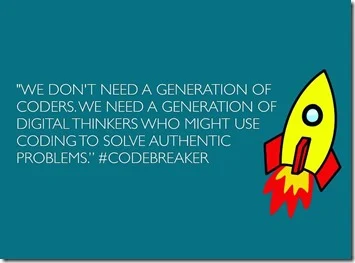
This message from Brian Aspinall was floating around in my social media the other day and it really resonates with me.

problem solvers

I’ve long said that we don’t need to teach computer science to create more computer programmers (coders). Now teaching computer science or programming does not automatically make people better problem solvers even if we want to really believe it does. But at least it adds another tool to the tool box.

I’m not sure I know what a “digital thinker” is but I am sure we need people who understand computer science. We are depending on computer science to help us solve an awful lot of problems these days. Leaders of the future are going to be in bad shape if they don’t have some understanding of the power and the risks of computer technology.

Monday, April 02, 2018

Is Computer Science Hard to Learn?

It’s been close to 45 years since I took my first computer science course. I really struggled with the first program. OK someone mostly wrote it for me. The third program we worked on together and the third I mostly wrote for the other person. People do seem to learn computer science at different rates. By now a lot of it seems easy. Programming in particular seems pretty easy.

It doesn’t seem to be so easy for students though.  Is it harder now or do I just not remember how hard it was when I started?  Does it take special motivation?

That’s just one thing I started thinking about while listening to Don Wettrick’s podcast with Doug Bergman and his students.

Doug Bergman: The Case for Computer Science in School’

Lots of good stuff in this podcast. Well worth the listen.

Thursday, March 29, 2018

But I Digress

Students sure are good at distracting teachers from the main topic. Especially if they have a teacher who likes to talk. I confess that I am someone who likes to talk (ok stop laughing those of you who know me.) I tend to think that some digressions are a good thing though. Sure it is not very helpful if students get me talking about my wife or grandson (or my son the principal for that matter.) On the other hand sometimes the best lessons come from a little digression.

Yesterday we were talking about validating data – specifically people’s names which are more complicated than many students realize. That alone can take on far afield. From there we moved on to validating credit cards and from there to validating passports. Yep, we got into check digits which I actually think is an important computer science topic. A few minutes to get students  thinking about that is a good thing.

Some years ago a discussion on loops lead to an unplanned set of examples of loops coded in multiple programming languages including Assembly language. A year later a student returning from university told me he thought that was the most valuable lesson of the course. I guess that worked out well.

Sometimes we as educators get a little too attached to our lesson plans. We MUST cover what we have planned for that day in just the way we have planned. We only have so many class minutes and a lot of stuff to cover. Over the years I have concluded that, at least for me, sometimes it is not just ok but very beneficial to digress a bit from the plan. Spending some time on something that students are actually interested in and curious about seems to help the rest of the material to go down better. Serendipity (a word I learned by chance when I was in high school) is a good thing.

As educators we have to be open to taking advantage of serendipity when it aids learning. Given just how much there is in computer science and how much more of it is then we can possibly teach in the time allowed this serendipitous learning may be the most important learning of all.

Wednesday, March 21, 2018

The Problems With Small Programming Projects

Most programming projects for beginners are small ones. They are focused on a specific concept that is under discussion. They are often forced in the sense that a professional programmer would seldom write them they way students are asked to write. They are concept examples or exercises. Often they are also boring. Mike Zamansky wrote a nice post about teaching refactoring  in which he says “Beginners work on small "toy" which don't lend themselves to good software development practices and later on, there's so much other material like algorithms, data structures etc. to teach and learn …”. And he is so right about that.

One of my favorite courses to teach is called Honors Programming which is only a semester long. I have some fun projects but most of them are small ones. Just when we get enough of t he basics to make really interesting projects the semester ends. In one of the Indiana Jones movies, Professor Henry Jones says  “You left just when you were becoming interesting.” How appropriate for my single semester course. I often wish I had a second semester to just take on a couple maybe two, maybe only one, that would really let us get into someone big.

I’d really love to dig into concepts like refactoring, real top down design, user written classes that have serious meaning and importance, code reuse, unit testing, and of course real planning. Multi-person projects would be great as well. I do some of that with smaller projects but there is so much more than can be done with a project of real size.

The existence of the AP CS courses makes a course like this hard to fit into the schedule. Yet another reason I am not a fan of AP CS. Heavy sigh.

What’s it like at your school? Do you feel the need for large scale projects or do you get to do them? Or do you think small projects are enough for now (high school?) and they’ll get to large projects later? Hint: Small projects are a thing in most higher ed programs as well.

Tuesday, March 20, 2018

Should We Do More With Spreadsheets in CS Education?

The Microsoft Research podcast has some very interesting interviews. One of them is How Programming Languages Quietly Run the World with Dr. Ben Zorn There are many fascinating things in this interview. Internet of things, security, software verification, and this interesting line:

So, by numbers, spreadsheets actually are the most important programming language in the world.

You really should listen to the whole podcast or read the transcript get get all of the value from it. I was fascinated, especially by the Internet of Things and security discussion. But the talk of spreadsheets is what I want to think about today.

I think many of us who teach computer science under estimate the importance and value of spreadsheets. They are ubiquitous today and are at the core of many things in business, industry, and even in our daily lives. At my school we teach them for a few days in our freshmen course. We don’t get very deep into them though. About the most computer science like thing we cover is if statements and conditional formatting. It’s a start but we are really only scratching the surface of what spreadsheets can do.

Given how many more of our students will be using spreadsheets later in life compared to how many of them will be serious programmers (using things other than spreadsheets anyway) should we be teaching them more? Or teaching them how computer science and programming are useful in spreadsheets?

I don’t know where this all fits in, or should fit in, to computer science curriculum. Should it be something that is taught by other departments with domain specific examples and issues? That would probably be nice as it would seem more relevant to more students. Teaching things in the abstract seldom “grabs” as many students as teaching in context does. But are teachers in those domains prepared to teach these things? At the university level, probably, especially with adjuncts with industry experience. At the high school and younger levels I am less confident.

So I have some thinking to do. I hope you’ll do some thinking about this and leave some thoughts in the comments. Let’s work on this idea together.

Monday, March 19, 2018

Advanced Placement Computer Science is a necessary evil for #CSforAll

Two controversial assertions in that title. That APCS is necessary and that it is evil.  I thought about leaving this post at that and seeing what sort of conversation started but that didn’t work on Facebook so I figured it would not work here either.

To start things off I should say that I am not a fan of the AP CS program. It’s too limiting. It is too tied to an end of the year test for me. The AP CS Principles course has more freedom than the AP CS A course does but still depends on an end of year test (and two performance tasks). Those performance tasks take up a lot of class time. I really like project based learning and I would love to have more time for larger projects. APCS courses suck the air out of the environment for other, more interesting to me, long term (year long) courses. I think there are better ways to prepare students for later CS education and careers. That’s the evil part.

On the other hand, the Advanced Placement brand carries a lot of weight with school administrators, school boards, parents, and other interested parties. It’s often an easy sale to these people as an argument for a new CS course.  If  we want to see “CS for All” APCS can be very helpful. But is is still necessary?

We have some well accepted starter courses in high school CS. Exploring Computer Science for one. Code.Org’s CS Discoveries is gaining some fans as well. They’re both good starters. In some ways I think they may ultimately lead to more high school Computer Science than AP CS will. But we’ll always want an advanced course to be the capstone of sorts. Should AP CS be that course(s) or should we have something more open-ended and less constrained by an exam?

What would you like to see at the top of the high school CS curriculum? Is AP CS the right answer? Is it a necessary course?

Friday, March 16, 2018

Impressive High School Computer Science Students–Made or Born?

ACM and the Computer Science Teachers Association (CSTA) announced the winners of the 2017-2018 Cutler-Bell Prize in High School Computing recently. Five students from four schools were given this award this year. One of the students was from a public school. The rest from independent schools. The public school has magnet programs but I don't know if the winner is part of those programs.

What does that mean? My best guess is that independent schools allow more flexibility for projects like this. Not just independent schools of course, schools like the Bergen County Academies and schools like Thomas Jefferson in Virginia clearly have a lot of flexibility, extra resources, and are open to encourage things like this. TJ had an awardee in both of the first two years of the award for example. But they are exceptional schools in more ways than one. They are not your typical public school. Looking back on the first three years of awards almost all of the awardees have been from either independent schools or public magnet schools.

It’s not just computer science though. Take a look at the schools who have had the most awardees in the Westinghouse-Siemens research competition. You'll see some familiar school names there. Most of them magnet schools.

My friend Mike Zamansky (blog Twitter) ways these awards say more about the students than the schools. I’m sure that is the case to some extent. But why so many of these students from magnet or independent schools? I think environment is important. If it were all about the student we would not see these clusters of schools that produce an outsized number of awardees.

I don’t know if the motivated students choose these school or the schools themselves develop this motivation. What I do think is that these schools have the flexibility to enable and support these students.  They also have a history of producing “winners” and a culture that sets high expectations but also provides help for students to meet those expectations.

Sure students from “regular” comprehensive high schools can and do earn these awards. That is not the way to bet though. The question in my mind is how to we add the flexibility and support to more students at more schools?

Thursday, March 15, 2018

ACM and CSTA Announce 2017-2018 Cutler-Bell Prize Student Winners

Some cool projects which you can read about here.

For more information about ACM/CSTA Cutler-Bell Prize in High School Computing, visit http://www.csteachers.org/CutlerBell or http://awards.acm.org/cutler-bell/.


ACM and the Computer Science Teachers Association (CSTA) have announced the winners of the 2017-2018 Cutler-Bell Prize in High School Computing. Five high school students were selected from among a pool of graduating high school seniors throughout the US who applied for the award by submitting a project or artifact that engages modern technology and computer science. A panel of judges selected the recipients based on the ingenuity, complexity, relevancy and originality of their projects.

The Cutler-Bell Prize promotes the field of computer science and empowers students to pursue computing challenges beyond the traditional classroom environment. In 2015, David Cutler and Gordon Bell established the award. Cutler is a software engineer, designer, and developer of several operating systems at Digital Equipment Corporation. Bell, an electrical engineer, is researcher emeritus at Microsoft Research.

The winners are Sreya Guha, Castilleja School, Palo Alto, California; Amir Helmy, Eastside High School, Gainesville, Florida; Amy Jin, The Harker School, San Jose, California; and Benjamin Spector and Michael Truell, Horace Mann School, Bronx, New York. The winning projects illustrate the diverse applications being developed by the next generation of computer scientists.

More at https://www.acm.org/media-center/2018/march/cutler-bell-prize-2017

Tuesday, March 06, 2018

Learning By Coding

Throughout my career I have increased my knowledge by working on projects. As a teacher who teaches mostly beginners I don’t see a lot of complicated code. No I take that back beginners write lots of overly complicated code. What I don’t often see, because I don’t often need, are new language features, library routines, or good new ways of doing things.

Now sometimes I have students show me new things. Sometimes they stumble upon them. Sometimes they  go on the internet looking for ways to do things. And sometimes they learn them from parents in industry. These are all good things but sometimes I still feel like I am stagnating. That I am not learning enough. Perhaps even falling behind.

This last week was school vacation. That means time to think ahead and to look at things differently. I did a bunch of reading. Mostly I read papers from SIGCSE. Yes, I pay money for the privilege but its worth it to me. I also wrote some code.

I’ve got to grade Explore Performance Tasks from my AP CS Principles students. Since feedback is important I decided to write a program to help me generate that feedback. What was involved isn’t really that important. In fact I suspect that writing the code isn’t going to save me as much time as it took to write the program.

What is important, to me at least, was that I explored some new things. A new Windows Forms object (CheckedListBox for the curious) for one thing. I also got in some practice with ForEach. That’s not new to me of course but I did think about it in some new (to me) ways. It probably doesn’t seem like a big deal. It’s not going to get me a raise or a new job or even add something new to what I teach in my current classes. On the other hand it is the sort of thing that helps keep programming fresh, interesting, and fun for me.

It may turn out that some student will come to me with a problem that needs just the sort of things I played with last week. That would be great. But even if not, continuous learning is a good thing.

Monday, March 05, 2018

Let The Computer Grade the Projects

It seems like a great idea – have the computer automatically grade student projects. Save all that boring work. Looking at all those projects is a pain. Why not have the computer grade them? It’s what happens in a lot of courses. Harvard’s CS50x online version does it so it must be great. In fact  a lot of huge courses in major universities use automatic grading software. What could be wrong about all of that? I confess that its a very tempting idea at times.

I’ve played a little with software looking at projects with some simple HTML projects. For rote stuff like making sure all tags are present and that open tags have matching closing tags is pretty straight forward. I still want to open the pages in a web browser to see what they look like.

Programming projects? I’m not so sure about automated testing for students. Mike Zamansky blogged recently about a session at SIGCSE (Sigcse2018 - Malloc Lab) where a professor had to deal with students gaming the grading system. This is one of my biggest concerns with automatic grading software. It is easily “game able.”

Getting to the destination is only part of the story. It’s pretty important to understand how students get the results they get. We, as educators, only learn so much by seeing the results of a program. We really need to understand how the programs process inputs and generate outputs. When we read student code we learn a lot about our students. We learn what they know and don’t know.  We learn how they implement algorithms. We also see what they understand and don’t understand. In fact we also get to know our students better. We learn their coding the way English teachers learn student's writing

Students benefit as well. We can give them a lot more feedback than automatic grading routines can give. We can also modify how and what we teach based on what we learn from reading their code. So for now I think I will put up with the extra work. The extra benefits are worth it.

Thursday, March 01, 2018

Registration Now Open for Computer Science Teachers Association’s 2018 Annual Conference

The Computer Science Teachers Association’s 2018 Annual Conference will take place July 7-10, 2018 in Omaha, NE. Don’t miss out on this world-class professional development opportunity, and the ability to network with peers in the computer science education community. Register today at: cstaconference.org

I’ve taken a look at the conference program (http://www.csteachers.org/page/2018conference#program) and it looks amazing.

Monday, February 26, 2018

Cyber Security or Just Good Program Design?

People continue to share things that they learned at SIGCSE online. Recently Ria Galanos, from Thomas Jefferson HS, shared Cybersecurity Modules: Security Injections|Cyber4All @Towson These ae a bunch of modules for teaching about various security issues like integer errors, Input Validation, and buffer overflow. Examples are in a number of languages including C++, Java, and Python. Looks like great stuff really.

From what I understand the majority of security vulnerabilities in software are a result of one of these three types of errors. Clearly they are important concepts but we don’t spend a lot of time talking about them in beginner classes. That probably needs to change.

It seems like we keep adding things to what we should be teaching beginners. Ethics, Accessibility, Security, and let's not forget the stuff for the AP Exam. How do we fit it all in?

Ultimately we have to do things in parallel. I think we have to think about ethical computing, safe programs, and accessible software as all part of good, solid program design. I think it is a mistake to think about all of these things as separate units to be taught in isolation. Projects can be created that integrate security, accessibility, and more by defining them all as good design. Not something special to do just for security or just for accessibility but for sound design.

Now to go look at my projects and see how to do all of that.

Friday, February 23, 2018

Accessibility and Computer Science

I’ve been following, as much as one can, the SIGCSE conference via Twitter this week. One of the comments I read talked about how many places don’t teach accessibility because they don’t see it as part of computer science. I can see that – sort of. On the other hand, accessibility is really an important part of human computer interaction and few fail to see that as an important part of computer science. Human-Computer Interaction is one of the 18 Knowledge Areas discussed in the CS 2013 Final Report

These days are we increasingly recognize diversity as important in teaching computer science I think it is important to realize that accessibility is essential for improving diversity in all areas. That means it should be included in any discussion of Human-Computer Interaction.

Speaking of HCI, the video below is a fun and useful look into what HCI and good design means. It was shown at SIGCSE by Tim Bell of Computer Science Unplugged.

Thursday, February 22, 2018

Modeling Good Coding Practice

Facebook showed me this cartoon this morning.

Programming alone

Teaching computer science means you are often programming while someone watches. I confess that I have been known to write something “quick and dirty” but that is not really an option for anything that students might ever see. Or really anyone else might see. “Do as I say not as I do” really doesn’t work for anything.

Generally I’m pretty careful about how I write code while I am doing a demo or creating a scaffold project for students. It requires a few extra minutes but I think it is important to model good practices. I think I have to make a point of explaining why I am taking those extra steps as they are not obvious to beginners.

Sure it seems unnecessary to rename a label box when there is only one label box on the form. Or to change the text property of the form. Or any one of a number of things that appear to be cosmetic and that don’t keep the program from working. But habits are important.

I remember once asking my father why we had to have perfect table manners at home where no one could see us. My father explained that by developing the good habits at home we would be less likely to mess up in public. It’s a lesson that stayed with me. It is why,even in the small simple code, using good coding practice is important. That way you don’t have to think about it when the coding gets public.

Wednesday, February 21, 2018

Open Letter to People at #SIGCSE2018

The Annual SIGCSE Technical Symposium is taking place in Baltimore this week.  Some of the best minds in computer science education are sharing ideas in sessions, panels, birds of a feather, and hallway conversations. At the same time most of the people who really need that information – classroom teachers, adjunct faculty, and others teaching computer science – are not there to hear it. It’s reality. We can’t all be there. We are starving to hear about what people learn at SIGCSE though.
Now some of us who are members of ACM and SIGCSE will get the papers later but that only goes so far. My request to the people at SIGCSE is that they find ways to share some of the things that don’t make it into the printed papers. Things like the keynotes. What an amazing lineup of keynotes this year it is too!

And the birds of a feather and the hallway conversations and the rest of the stuff that is just so hard to capture.

How should you do it? Well lots of ways. For one thing live tweet the event. Use the official hashtag - #SIGCSE2018. There are people at home watching. We may even ask you questions.

Share things on Facebook. There are a couple of good groups there that would probably welcome SIGCSE posts. I can think of Computer Science Education: Researchers & Practitioners and Computer Science Educators as examples. Or post them as public on your own account so people can share them.

For another write posts on your blog. Don’t have a blog? I tell you what – I will post guest posts from SIGCSE attendees here on my blog. Send them to me at act2@acthompson.net with your attribution information and I’ll post as many as come in.

Consider offering to talk about SIGCSE at a future local CSTA chapter meeting. You’re probably going to share information at your home institution but there are lots of others who would love to hear about what you learned at SIGCSE.

Programming Patterns For Beginners

Ever since I read those papers on the Rainfall program (How Hard Is That Programming Problem?)  I’ve been thinking about patterns in problem solving and programming. There are many of these types of patterns in programming but most of us learn them through experience.

The Rainfall problem is one example. It’s basically a counting and totaling loop that handles exceptions. Anyone who has done one of those (or maybe two if they are like me) probably sees that pattern as soon as they read or hear the problem statement. It’s new to beginners though.

One of my favorite patterns (much more complicated for beginners to see) has to do with avoiding special cases for boundary conditions. Take for example the lights out project (Taking Things To Another Level ) it involves checking the squares above, below, to the left, and to the right of a box in a 5 by 5 grid. Beginners tend to see that as calling for special cases for the corners and edges. Experienced programmers create an invisible row above and below and an invisible column to the left and right of the visible grid which allows all boxes to be checked the same way. It’s a pattern many of us have seen before.

After a while I think most of us don’t even consciously think “oh that is a pattern I have seen before” but we just go with it. Of course there are far too many patterns to teach all of them in a single semester (or single life time I suspect.)

lately I have been asking myself “what are the most common patterns I can think of and how to I create projects to give students experience with them?” And more than that, how can I get them to recognize those patterns in the future? I can’t assign enough projects so I think we’ll be reading some code. Maybe playing with Parsons Problems. But definitely I need to have students read more code.

Do you teach patters explicitly or just implicitly? What patterns do you see as most important for beginners to learn?

Friday, February 16, 2018

Self Driving Everything

Nissan put together this cute little video that starts with self driving slippers and moves on to self driving pillows and chairs and, well, watch it.


What's next? That is the question I would ask students - what else should be self driving? And why?

Thursday, February 15, 2018

Jumanji and the While Loop

Cultural references (term used loosely) can make projects and exercises more interesting for students. Now that there is an updated version of the movie Jumanji out I decided to use that reference again for working with while loops.

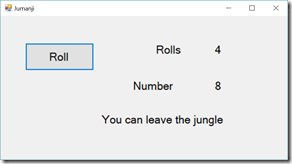
If you remember the movie, you will probably remember that people playing the game can be forced to wait in the jungle until another player rolls a 5 or an 8. There are several ways you can use this in an exercise. You can “roll” dice once and use an if statement to report if the person can leave the jungle or not. OK but boring. Or you can simulate rolls to see how many “moves” it takes to get someone out of the jungle. That’s what we did.

There are several things I like about this exercise. We start by asking if the loop should check at the top or the bottom. Of course you can write it either way but the discussion is the valuable part.

Next we take on how the Boolean expression is formed. Finally we talk about the code inside the loop. One die with a range of 1 to 12 or two die with a range of 1 to 6? Which one better simulates real game play and why? Finally we talk about how to do the counting inside the loop.

image

All in all I find it a helpful exercise. As a demo it is simple enough to show the basics but involved enough to have some good conversations about how and why we do things different ways. And it is relatable to things outside of school.