Monday, September 17, 2018

The Multiple Natures of Computer Science Education

There was a lot of good CS education activity on Twitter this past weekend. I know I missed a lot of it but some things did stand out for me. One of these was this Tweet from Hadi Partovi, co-founder and show runner at Code.Org:

image

This is not really new of course. But it does highlight the fact that we can’t look at CS as all analytical and miss out of the creativity inherent in it. If everyone in the class turns in a project that looks identical do we really know if they understand the concepts or are they just good at following directions? Does everyone come up with the same solution? Or do you, the educator, see solutions that are different from what you would come up with? Letting students getting creative makes things more interesting and motivating.

Likewise CS is not just for the college bound or for the career bound. Comprehensive high schools and vocational high schools do tend to look at CS education very differently. We have to be careful that we achieve some balance here. We can’t ignore the tools completely and keep it all theoretical. Nor can we get so deep into the tools that we ignore the concepts that drive the tools.

We have to avoid being the blind men judging the elephant only one what is in reach. We have to share more of the elephant with our students so they become whole people and not limited by too much focus.

Sunday, September 16, 2018

Preparing Students to Ask Questions

I drove behind a Google Maps Street view car for a couple of miles today. Things I wondered about:

  • Will my car show up on Street View?
  • What is it like to be one of those drivers?
  • What sort of meta data are they collecting?

That last question is key. I thought of that because I know something about computer science. I also know that there has be controversy about this in the past. I think I would have wondered about the meta data anyway though.

What is the meta data? What is it used for? Who has access to the data? Lots of questions of the sort we, society, need people to ask. Not just computer scientists but all sorts of people. How are they going to know to ask if they don’t understand what meta data is or how it can be used?

Getting people a basis of knowledge so that they know to ask questions is every bit as important as the “answers” we make them show on exams and quizzes. This is why we need computer science for everyone.

Monday, September 10, 2018

Do We Really Need CS Focused High Schools?

Last week Bill Gates visited the Academy for Software Engineering, a computer science focused high school in New York City. and wrote about his visit. At first reading I was thinking the visit was a good thing. I still think it is – for the most part. Mike Zamansky had an interesting take on the visit (That Time Bill Gates Visited AFSE) that got me thinking.  Basically I like what AFSE is doing but after reading what Mike wrote, I wonder if we really need CS focused schools or could we just do all that stuff at “regular” high schools?

The design class that Gates writes about is a lot like the one my wife teaches at a small, semi-rural high school in New Hampshire. It’s not a CS focused school at all. In fact, their CS offerings in general are pretty limited. But that doesn’t mean that CS concepts can’t be included in other courses or introduced in middle school exploratory courses.  What is takes is administrative support and a trained and motivated teacher. And CS is growing there!

Also last week, Porter-Gaud, a private school in South Carolina, released a video about their two high school CS teachers (Doug Bergman and David Renton – both friends of mine who I admire greatly) and some of that they are doing with their students. Among other things they have their seniors writing software for virtual reality headsets. (Do check out the video of The CS Dymanic Duo )

Porter-Gaud is a college preparatory school not a CS focused school. And yet they have an absolutely amazing computer science program. Again, what they have that many other schools do not have is an administration that is willing to support teachers who are creative, motivated, and willing to learn on their own or (even better) with their students.

We know from several recent surveys that parents want more computer science education.  It is tempting to think that specialized schools are the answer. A lot of people think that CS is not for everyone. Wrongly as evidence strongly suggests. We are also faced with a shortage of teachers with the background to teach more advanced CS and that makes sending them to specialized schools attractive.

If we focus too much on special schools I worry that we perpetuate the idea that not everyone is cut out for CS or that not everyone needs to learn CS. A school like AFSE is trying a lot of things to merge CS into other subjects. That’s a great thing but it will be even greater and more influential if the things they learn about integrated curriculum is shared with comprehensive high schools.

In the long run we as a society will benefit more from things learned in CS focused schools migrating to the wider population of schools than we ever will from the small number of students who pass through these schools.

Wednesday, September 05, 2018

NCWIT Award for Aspirations in Computing–Recognize Girls in Tech

Recipients of the NCWIT Award for Aspirations in Computing receive engraved awards, scholarship and internship opportunities, entry to a peer-network of technical women in the NCWIT AiC Community, various prizes, and more. // Share this status with women in grades 9-12 who should apply! www.aspirations.org/AiCHSAward

Several of the girls in my school have received this award in the past and it has been impactful for them. Highly recommended.

image

Tuesday, September 04, 2018

Why Teach Binary in Computer Science Classes

Sometime when I was around age 11 or 12 I learned about different number systems. I was fascinated with the concepts involved. I literally spent hours experimenting with them. This stood me well when I started studying computer science. We were using Binary, Octal, and Hexadecimal. Octal and Hex are useful for grouping Binary into groups of three (octal) of 4 (hexadecimal). I worked on computers back when one could, and did, toggle code in Binary using switches on the front of the computer. It was awesome.

I’m still fascinated with these systems. I have a Binary clock on my desk and six sided Binary dice in my desk drawer. And of course I try to teach Binary in particular and number systems in general. I’m still surprised that students don’t enter high school knowing this stuff but I guess priorities in education change.

In any case, if you do an internet search for “teaching Binary” you will find a lot of resources and discussions about the how to teach. (My own list is at Resources For Teaching Binary Numbers FWIW) What I don’t find a lot, at least not easily, is justification for why we should teach Binary numbers. It’s obvious to us old-timers. It’s in the curriculum and standards for new teachers. That’s good enough for most of us. For students? Well, students want to know why it is important to learn something.

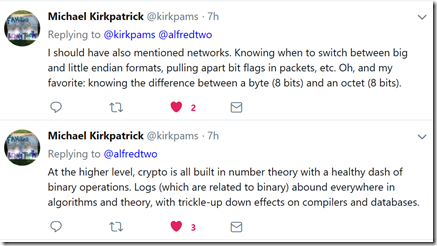
I asked teachers on Twitter what they said to justify teaching binary. I got some good answers.

image

image

image

image

image

There are more reasons as well. Binary explains the limits around the values different data types can hold. That is a key one to me.

Now I want to organize my thoughts and figure out how to present things to my students when I next cover Binary and number systems. Letting students know the importance and having context is bound to help students see the value to what  I am teaching.

So, how do you explain the importance of learning Binary in computer science?

Wednesday, August 29, 2018

Teaching Programming with Blocks vs. Teaching with Text-based Languages

Blocks or text? Which should I use with beginners? On one hand, I read research backed articles like Mark Guzdial’s High school students learning programming do better with block-based languages, and the impact is greatest for female and minority students which strongly suggest I should be using Block based programming languages. Well, at least in the first course. On the other hand, I had programming in block-based programming languages.

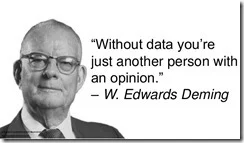
a-collection-of-quotes-from-w-edwards-deming-4-638Sure it should be an easy choice – go with the research. Sometimes I hate data. What happened to when we could all just go with our guts?

Seriously, it is hard to argue with peer reviewed data and I am rethinking a lot of things. I currently teach four different courses and each one uses a different programming language. Advanced Placement uses a combination of block-based programming that migrates to text-based JavaScript. That’s ok I think. Most of these students have had previous programming in either or both blocks or text languages.

My mobile application programming course does use a block based programming language (currently AppInventor) and it works well there. Most of these students have had very little if any previous programming experience. The pace is slower than my honors or AP courses and students seem to like it. I need better assessment tools to really understand how solid of a foundation they have for future computer science and programming. That is something I am working on.

My Honors Programming course uses C#. These are students who, for the most part, are highly motivated, have a good base to build on, and want to be challenged. I think C# is a good language for them. Opinion I admit.

Where I am really having to think hard is with our freshmen class. We currently introduce programming with Visual Basic. Should we be using a block language? Maybe. Unlike the other courses I teach I am not the only teacher. I teach two sections out of a total of 11 or 12 sections. Three other teachers also teach sections and the department chair teaches more of them anyone else. So it is not just my call. At least not for everyone.

What I am currently thinking about is doing a pilot with my sections. What I need to do first is come up with some sort of way for use to assess the difference (if any) in results. Since I teach the second course for many of these students I could look at who takes more programming and how they do with the next course but that takes a lot of time. And how do I know if the language used influences (and in what direction) if students do or do not take more programming?

I guess I have research to do. On the other hand, if there are some of you who have made this sort of change and would like to share what they have learned I’d love to know about it.


Saturday, August 18, 2018

Programming FUNdamentals Books

Most programming textbooks just are not what I am looking for. They are too long. They are too dull. And they are written for teachers to use not for students to reference. Last winter I decided to write some thing for my students to use. Actually, two books for my students to use. II took some short suggesting papers I had written, used my PowerPoint lecture presentations for some details, and basically wrote what I teach.

I teach some Visual Basic programming to freshmen and C# with my Honors Programming classes. That’s why two books.

These are not typical textbooks. They are short, to the point, and, I hope, will not put students to sleep. There are few exercises and no end of chapter questions to assign. They are intended more for students to use as a reference. Students tend not to take good notes so these may fill that need for some. They also want to learn things that are not generally looked on as serious computer science but which make for more interesting programming projects. So there is a section on how to do fun things with timers, images, and other language/library features that I get asked about regularly.

They’re probably not for everyone but the drafts worked well with my students last year. Take a look and if you like what you see buy one (or a classroom set). They’re priced low at $9.95. If they suck, send me an email. I’ll try to do better in a second edition.

Thus ends my commercial

Fun books

Wednesday, August 08, 2018

Computer Science Education Progress in New Hampshire

Things have been moving right along in New Hampshire. First we developed CS teacher certification (a joint effort with the department of education and a team of computer science educators). Now we have CS included in the legal definition of an adequate education as of earlier this summer. A set of CS standards, based on the CSTA Standards and K12 CS Framework have been adopted officially this week. Implementation plans are in the works. The latest announcement I received follows:


On June 18, 2018, NH House Bill 1674 was signed into law.  https://legiscan.com/NH/text/HB1674/id/1656822

This bill renames our "ICT Literacy" program to "Digital Literacy," and adds Computer Science (CS) as a core K-12 subject area.

The NH Department of Education is currently working on the program rules (ED306) that will implement this law, as well as a timeline for developing CS programs.

We are looking at a two-year implementation timeline, with a target date in 2020 for districts to have programs in place.

There will be additional opportunities for educators and the broader public to provide feedback, with information posted on this group and on the Department website.

Additionally, the NH State Board of education today (August 8, 2018), voted unanimously to adopt the NH Computer Science academic standards.  Part 1 of these standards, "Context and Guidance,"  provides additional clarification about the relationship between digital literacy and computer science, how CS relates to STEM and other disciplines, and recommendations for developing or strengthening programs.  Part 2 is the grade-band standards.

The standards, and additional resources, are available here:  https://www.education.nh.gov/instruction/computer-science/

The policy tour slides provide a concise overview of our computer science policy efforts.

The Department of Education will continue to support implementation of these policies through federal and state grant programs, partnerships, and guidance and support.

Sunday, August 05, 2018

Computer Science and Farming

One of the things I tell students is that computer science is relevant to a lot of careers that they may not think of at first. An announcement I read last week and a visit to a farm reminded me of that this past week.

The article was about a joint effort between Microsoft and the Futures Farmers of America. (Future Farmers of America, Microsoft to develop tech-based agricultural curriculum) The FFA is an amazing group that does a lot to help prepared young people for careers in farming. Modern farming is a lot more than sticking seeds in the ground and waiting for plants to be harvested. Actually it has always been a lot more than that but technology has long had an expanding role in making farming for efficient and productive.

As I said, I also visited a farm last week. The owners are friends of mine and they are working other jobs as they build up the farm. Technology is a big part of how they manage things at the farm while not living there full time. Obviously there is we-fi available throughout the a farm. There are remotely accessed cameras and a very nice weather reporting system for starters. As I toured the farm we talked about future efforts.

One thing under consideration is RFID tags on each of the trees in their apple orchards. This would allow notes to be easily taken and recorded on the condition of individual trees. Other thoughts include computer (and remotely) controlled irrigation. Being able to pay more and better attention to individual plants or parts of a farm - precision agriculture – is something that computerization makes practical.

I’ve been reading about using computers to plan grazing patterns that make for more productive pastures, robots that scan and treat individual plants at high speed, and artificial intelligence analysis of aerial photographs of crops. I think we’re on the verge of a big jump in technology use in farming with a jump in productivity and efficacy in farming. Pretty darn cool!

Friday, August 03, 2018

School is Getting Close and Teachers Are Getting Ready

Two weeks from today I return to school for teacher orientation. Students come in the next week. summerThings are getting real. While I have been thinking about school a lot ever since the end of the last school year there is a renewed sense of urgency kicking in.

I’d like to report that I have solidly worked my plan (School Year is Over, Time to Get Ready for Next Year)  but that would be an overstatement. The start of a new school year seems so far away when one school year ends. It sneaks up on you.

The other day I got access to the learning management system with my classes enabled. I uploaded a lot of the resources that I have been preparing. That helps me feel like I am closer to being ready. I’m a little behind where I wanted to be but ahead of where I was this time last summer.

So the crunch is on! I’m working on the details for the first couple of weeks of classes. I’m outlining some things I will need later. I’m used to doing some things “on the fly” by which I mean adapting projects to the interests of the particular class. It is always amazing how much difference there is from one section and another in the same year or from one year to another. I don’t want to straightjacket myself. I don’t want to be totally without plans and options though.

I should get to it. I should also prioritize school prep over blogging. See you later.

Thursday, August 02, 2018

Encourage US High School Students to Apply for 2018-2019 ACM/CSTA Cutler-Bell Prize

Do you know a student working on an amazing computer science project? Maybe they need some recognition to take them to the next level. The Cutler-Bell Prize may be just what they need.


Every year, the ACM/CSTA Cutler-Bell Prize in High School Computing recognizes talented high school students in computer science. The intent of the program is to promote and encourage the field of computer science, as well as to empower young and aspiring learners to pursue computing challenges outside of the traditional classroom environment.

The application process involves a Challenge that focuses on having the student develop an artifact that engages modern computing technology and computer science. Judges will be looking for submissions that demonstrate ingenuity, complexity, relevancy, originality, and a desire to further computer science as a discipline. The application period closes January 5, 2019.

Up to four winners will be selected and each will be awarded a $10,000 prize, which will be administered through the financial aid department at the university the student will attend. The prizes are funded by a $1 million endowment established by David Cutler and Gordon Bell.

Detailed information, including the link to the online application, is available on the ACM/CSTA Cutler-Bell Prize in High School Computing website. Winners of the 2018-2019 Cutler-Bell Prize will be notified via email in February 2019.

Thursday, July 26, 2018

Ethics, Accessibility, and Security–Condiment or Ingredient

Too often people think of ethics, accessibility, and security as condiments; something to add at the end rather than ingredients essential from the beginning.

Last night was the latest #EthicalCS Twitter chat and as usual it got me thinking. A pretty common occurrence during those chats BTW. The discussion was of course about ethics but I was thinking that people see ethics as an add on – something to tag in as a filler in a course or a later thought in a project. The same seems to be true about some other things like system security and accessibility.

These are all related in some ways. An ethical system is accessible and secure for example. More importantly, though they have to be baked into the system. They have to be considerations from the start if they are really going to be the best they can be for the most number of people.

As educators I think we have to make sure that our students learn that. Learn it by example, by discussion, and by plan.

Wednesday, July 18, 2018

Updated ACM Code of Ethics Released

ethics ACMThe ACM has released the latest update for the ACM Code of Ethics. It’s an interesting and important document. I wonder how many computing professionals know about and try to follow it though.

Clearly, as computing becomes more and more a part of daily life ethical practices become more and more important. As an educator I see it as my responsibility to make sure my students know about it though. The word “ethics” appears 100 times in the CS 2013 Curriculum report with specific mention of the ACM code of ethics listed as a reference and resource.

As I plan for the new school year I am thinking about how to incorporate more ethics discussion into the curriculum. I really want students to think, and think hard, about ethical issues.

Monday, July 16, 2018

Is This The Future?

Narrator: Alfred Thompson, you’ve just attended an amazing CSTA Conference. Now what?

Alfred: I’m going to Disney World!

magic bandAnd so I did. I just got home from about 5 days at DisneyWorld with my family. It was a great time  and I spent a lot less time online than usual. That doesn’t mean I wasn’t thinking about technology though. At DisneyWorld technology is everywhere. For most visitors this wrist band is the center of much of the activity.

It’s called a Magic Band and basically it is a cool container for an RFID chip. This band serves as the key to ones hotel room, a charge card, admissions to the various parks, and more. It’s not the only RFID chip one will run into though.

Fall-2015-Disney-World-Refillable-Resort-Rapid-Fill-Mugs-5-453x600Even the beverage containers also have RFID chips attached. The most obvious to may people are the refillable mugs. These mugs allow unlimited refills for a specific period of time. The dispensers only work if they read a valid RFID chip. Yes, in case you are wondering, even the paper cups have chips in them. The chips in the paper cups allow for a specific number of refills. I wish I had brought one of them home to play with. Anyone want to send me one (or more?) I really want to experiment with RFID.

So this is cool technology. The question really is, is the a utopian future or a dystopian future?

Disney uses this information to make the guest experience better. Well, that’s the theory and I suspect it is largely the case. I’m sure it helps them make money as well. No doubt it is useful to know how many refills people take. Tracking visits to the parks tells them a lot about guests interests and routines. Who knows what else they know about.

But what about outsiders using the data? Other companies? The government? What information can or does Disney provide to law enforcement and under what circumstances?

There is also the question of people with malicious intent stealing information. Not just from Disney RFID chips either. More and more credit cards and other ID cards are using RFID chips. My newest wallet is advertised as blocking RFID signals so apparently a lot of people are concerned about this sort of thing. With good reason I think.

The potential uses of RFID are both good and bad. We can use them for many things but should we? Good stuff to talk about with students. I think they need to understand this technology, how it works, and what its risks and benefits are.

Thursday, July 12, 2018

Microsoft Makes Large Commitment to CSTA

One of the big announcements at the recent Computer Science Teachers Association conference was that Microsoft is donating two million dollars to CSTA over the next three years.

This is obviously a big deal. This money is first off a huge help towards building a strong financial base for CSTA to grow and to do more. It will allow more professional development, more help to local chapters for new programs, and generally make some long desired programs to happen. It is also a great vote of confidence in CSTA and its leadership.

I was able to chat with Mary Snapp, Corporate Vice President and Lead for Microsoft Philanthropies, who announced this grant at the conference. She told me that Microsoft strongly believes that CSTA is going to be able to expand and scale operations in a big way over the next few years.

A number of companies I talked to at CSTA told me they are interested in helping build computer science education. They all really need people who understand computing. Not just to hire (though there is some of that) but also the companies they partner with and sell to need more people. And of course a society where people understand computing is a benefit to us all.

So thank you Microsoft. And thank you to the other companies supporting CSTA in various ways.


Wednesday, July 11, 2018

Taking the Microsoft Technology Associate (MTA) Exam

Contrary to popular opinion I did not do it for the free t-shirt. Certaport was offering teachers at the CSTA Conference the opportunity to take a MTA exam (or exams) for free. If you passed you also got a t-shirt with your certificate. I had other reasons to take it though.

Yes, I wanted to test myself a bit. I had not studied for any of them and I hadn’t planned on taking any exams. When several of my friends took exams (and passed of course) I decided maybe I should try. I chose the Block Based Programming exam because I teach some block based programming. The exam is currently based around TouchDevelop which has been discontinued but the exam will be rewritten for the blocks in MakeCode.com soon. In any case, I know some TouchDevelop so it seemed a good choice.

More importantly I was curious as to how the tests were given. What sort of questions where asked? How are they presented to the test taker? And more process sorts of questions.

It turns out that questions are asked several ways. There are a few ordinary multiple choice questions. There are a few questions where you have to read and understand code. There are also questions where a problem is explained and code is shown with “holes” that you have to fill from drop down lists. There are also Parsons Problems types of questions. In these you are presented with a problem, 6 to 8 lines or blocks of code and asked to place the right blocks in the correct order to solve the problem. There are usually extra blocks of code. It’s harder than you might think. There were also questions I would categorize as software design or software engineering questions.

In fact, the whole test is harder than you might think. You really do have to think and I was concerned about the 60 minute time limit for the 39 questions. My friend, Doug Bergman took the Java certification and told me he thought it was Advanced Placement CS level of hard. I feel pretty confident in saying that these are rigorous (especially for first level certifications) exams.

I wish I had a system like that to give quizzes and exams to my students. Especially the Parsons Problems style of questions.

Oh, yes, I did pass and I did get my free t-shirt.

Tuesday, July 10, 2018

Reflecting on #CSTA2018

I feel like I have really fallen behind on reporting on the CSTA Conference in Omaha. Part of the problem is being a bit overwhelmed. Usually I write blog posts in boring sessions. I didn’t attend any boring sessions.  I have to absorb some of it and I will write a more detailed post soon. I hope.

Right now I am sitting in an airport waiting for a delayed flight and not up to gathering all my notes. Who am I kidding. What I have for notes are tweets I have posted with the #CSTA2018 hashtag. A lot of people tweeted a lot of good stuff and others have already posted summaries on blogs.

This conference was a bit different for me. I wasn’t there as a presenter, a CSTA board member, or representing a company. Just me – teacher from New Hampshire. In some ways that was freeing but it felt different. The size of the conference is different as well. Back when there were 50 or 60 of us at the conference I knew almost everyone. At 700 attendees there was an amazing number of new faces. First time attendees. People brand new to teaching Computer Science and people in district roles that didn’t exist a few years ago.

That’s not a bad thing at all. It’s a great thing. When we were so small a group we risked too much group think. Now we have lots and lots of views. Having people with so many backgrounds and experiences is an amazing opportunity. So while I loved spending time with people I have known for years and years it was wonderful to meet and talk to so many new people.

A lot of people told me they read this blog or follow me on Twitter (@AlfredTwo) which was very encouraging. Like many who post to social media I don’t always know if there is anyone out there or if I am yelling in a vacuum. Speaking of Twitter. I talked about that already but it was humming. Lots more teachers are tweeting these days. It really is a good way to share information.

The exhibit hall was a lot larger this year,. I blogged about that the other day (Pictures From #CSTA2018) and I really appreciate the companies and organizations (three universities for example) who show up to talk to teachers. Even at 700 attendees, CSTA has an atmosphere that is a lot more conducive to real conversations with exhibitors than a conference like ISTE or TCEA (as great as those conferences are in their own ways.)

There were a lot of people who were at CSTA because of company funded scholarships. Rolls Royce funded about 25 people (including me). Oracle Academy provided grants and goodie bags to a bunch of people. Google provided money for CSTA Chapter leaders to come for two days of special training and the conference. This is real support of teacher development. These companies understand the need for teachers who actually know what they are doing and are willing to put some money behind their talk.

If you were there and we didn’t connect I am sorry. 700 people can make that harder than we might like. I hope though that you had some great conversations with others and learned as much as I did.

Next year CSTA will be in Phoenix, Arizona from July 7th to 10th, 2019. It’s going to be even better. I just know it.

Monday, July 09, 2018

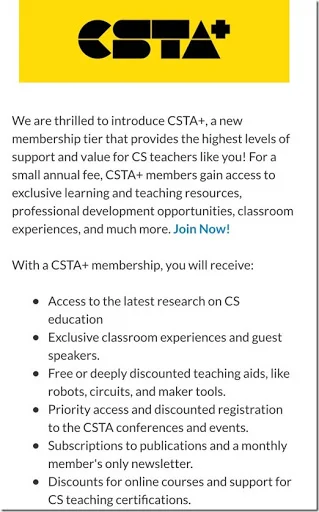
Computer Science Teachers Association announces CSTA+

One of the big announcements at CSTA today was a new premium level of membership in CSTA. There is and will continue to be a free membership. This new premium membership offers some additional benefits and will also provide money for local chapters. Half of the CSTA+ dues will go to local chapters to enable them to expand their program.

This is something that has been under discussion for several years. My local ISTE affiliate, NHSTE has had a similar two levels of membership for some years and I have benefited from that paid level. I expect this CSTA+ membership to be well worth the money. Yes, I’ve signed up!

Find out more at CSTA.plus There you can find some additional benefits and sign up.

CSTA Plus

Sunday, July 08, 2018

Pictures From #CSTA2018

Before I get into some pictures of the exhibit hall let me tell you that there are a lot of people here. This was lunch on Sunday.WP_20180708_12_35_44_Pro

Arkansas is in the house. A large and visible group from Arkansas. And they brought flags and pins and lots of personality. Arkansas is doing great things with developing CS for AllWP_20180708_12_36_49_Pro

The exhibit hall is much larger than in previous years and it really looks like a real exhibit hall. I went around while they were still setting up and took a few pictures. This is just a taste of who was there. I may post more pictures tomorrow but this gives you some ideas.

CoderZ showing off their virtual robots.

WP_20180708_13_45_58_Pro


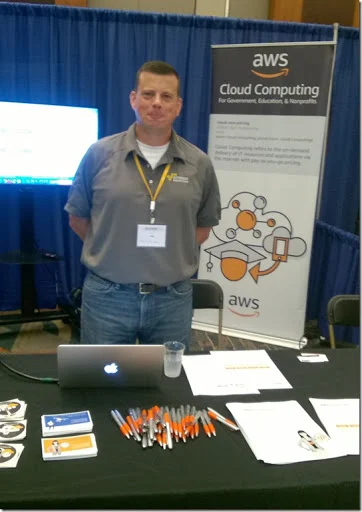
Amazon Web Services are here. No not selling books but sharing some of there tools and options for teachers to teach cloud computing. I will be looking closer at this for my AP CS Principles class among other things.


WP_20180708_13_43_53_Pro

Birdbrain always has an interesting table. Physical computing is big again this year at CSTA.

WP_20180708_13_35_11_Pro

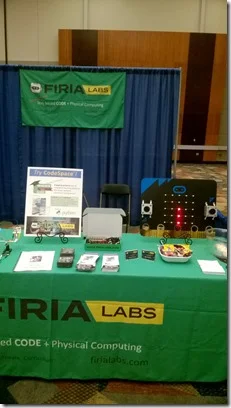
Is this the largest Micro:bit in the world? Firia Labs has some interesting things on display. I need to spend more time there tomorrow.

WP_20180708_12_30_41_ProWP_20180708_12_30_30_Pro

CodeHS has a big booth and a large team here. A great opportunity to talk to them about their offerings – free and paid. I used some of their free materials last year with my AP CS Principles students.

WP_20180708_12_29_41_ProWP_20180708_12_30_51_Pro

 Vernier had some great sensor projects. Some even programmed in Scratch. I have to get their catalogue. I want to make some of those projects myself.


WP_20180708_12_28_25_Pro


TEALS was here with a good crew. Very exciting program that places industry professionals in the classroom to co-teach with (and train) classroom teachers teaching computer science.

WP_20180708_12_20_07_Pro

IBM is at CSTA for the first time. They are talking about heir Master the Mainframe contest, IBM Activity Kits, and other offerings. Surprisingly mainframes are a growing business for IBM and there are jobs for people who understand them. I’ve heard from others that kids learn a lot from that competition.

 WP_20180708_12_07_06_Pro

And it begins–#CSTA2018

Yesterday opened the CSTA Conference with afternoon workshops. And there was a nice reception put on by Google. For me it was a travel day and a getting settled day for the most part. Thant and a lot of opportunities to have conversations. I didn’t take any of the workshops so I can’t report on them first hand but from Twitter it seems like they went very well.

chibiThe conference bag had some real treats in it though. The big surprise was this Chibi chip starter kit.  There is a microchip and accessories with a book. I expect a lot of people will have some fun with that.

I’m helping out at the registration booth for a while this morning. Volunteering is a great way to meet people as well as to help the conference run smoothly. I’m glad I had time in my schedule to do so.

After lunch the exhibit hall opens. There are a lot more exhibitors this year and I am really excited about that. My next blog will be a report on that.