Showing posts with label Mixed Reality. Show all posts

Friday, July 15, 2022

My Day Two at #CSTA2022

Day two started off great as I connected with several people from my home CSTA Chapter –CSTA New Hampshire. The CS community in New Hampshire is growing and the CSTA Chapter has been a part of that. I’m planning on getting more involved in chapter stuff  in the future.

My first session of the day was about teaching ethics when teaching artificial intelligence. Jeremy Keeshin (a last minute replacement as I understand it) from CodeHS was the presenter.  Seems like some good small group discussions took place. Maybe I was tired but I didn’t get into it very well. My fault. Wasted opportunity. I did get a copy of Jeremy’s book “Read Write Code” which I look forward to reading.

Next up for me was a session on preparing the future developers of the metaverse.  The presenters were from Carnegie Mellon. First I have heard of XR as a generic term to include Augmented Reality, Virtual Reality, and Modified Reality. We had some really interesting discussion of using virtual worlds in school. One school had a virtual birthday party in Minecraft. Minecraft has moved from pure play to an educational platform.

Students are picking different virtual worlds to play in as they age.It occurs to me that younger kids are building things in games like Minecraft and Roblox but older students, especially boys, and moving to games like Call of Duty which are more destructive. Something to think about.

My number one to look more into is Arena XR – An Augmented Reality Edge Network Architecture.

I really enjoyed this session and had some good interactions and learning with my tablemates. Slides for this session are at CSTA2022 NoStudentLeftBehind.pdf - Google Drive

Lunch break and more time in the exhibit hall. I got a close look at the Jacdac devices for use with a Micro:Bit. I may splurge and buy a starter kit. Note that I posted a brief look at Microsoft and other big companies exhibits at Amazon, Google, Meta, and Microsoft at #CSTA2022

First afternoon session was about writing for Hello World magazine. I was proctor and arrived before it started but after most people entered the room. Watching the clock is important as it is so easy to get distracted with so much going on. Anyway, the slides for this talk are available at CSTA_Writing Workshop Presentation.pptx - Google Slides  A lot of good stuff here. I hope this gets more teachers to write for the magazine.

Next up was a session on cryptography with an exercise in creating a Pringles can Enigma machine. We started the session with an brief introduction to Cyber.org and with an introduction to the Pigpen Cipher. (Note that this is one of the ciphers covered in my (PDF) free Tiny Book of Simple Cryptography)  We had some fun creating our mini Enigma machines and working though how they work. We only used one rotor but I brought home some sheets to make a larger one with a larger can when I get home.

Overall, a pretty good day. Some very good sessions, some good conversations at the exhibit hall, and many amazing face to face conversations with friends. I am exceedingly glad to be here this year.

Tuesday, March 19, 2019

Interesting Links for Computer Science Educators 19 March 2019

I haven’t done one of these for a while. I still Tweet or retweet a lot at @AlfredTwo but I needed a break. I’m not sure I will do this every week but I think I will shoot to do it from time to time.

Microsoft Education posted a bunch of resources on Ways to encourage girls to keep pursuing STEM this Women’s History Month There are some posters I think will show up in my computer lab soon there as well as other helpful links.

David Renton is doing some amazing things with his students who are programming virtual reality applications. Currently he is having Students Build International VR Prototypes for Children This is more than about computing. It is a multi-national effort with some support from Microsoft in the UK and deployment at a hospital in Sweden.


Mike Zamansky has a  great post about Adapting A Nifty Assignment  You may or may not be familiar with the SIGCSE Nifty Assignments sessions, check them out if not, but they are pretty nifty but many of them really do benefit from adaptation to a particular environment.

I found this on the Blog at CACM I don’t know about you but calculating with Roman numerals (what no zero?) was something I wondered about. This article explains it all. I wonder if this might make a nifty project? Calculating With Roman Numerals is Not So Difficult 


Speaking of SIGCSE, Bryan Twarek provides a nice list of K-12 Teacher Takeaways from SIGCSE 2019  on the CSTA Blog. Not as good as being there but Brian includes a bunch of related links.


Under my list of things to keep an eye on, Microsoft had a post called Achieve more with Microsoft Game Stack It looks mostly like a repackaging or rebranding of a number of new and existing resources for game developers. Will it have application for schools? Maybe in game development courses but even there it seems like Game Stack is more for professionals than beginners. But we’ll see if anyone in education takes it on and provides information.

Tuesday, January 01, 2019

Happy New Year 2019

I’ve been thinking about this post for the last several days. My usual practice has been to start the year with a list of things I want to watch in CS education during the coming year. As I look at last year’s list (see Looking Back on CS Education in 2018) I don’t see a good list for this year. The things I’ve been watching have largely matured. The next big growth area is not clear to me.

Sure we’re making progress in getting computer science education for more and more people. Of course there is more to do and room for growth but it feels like momentum is going to carry us through.

So this year I am thinking about what I can do to give my students an edge. What can I shoehorn into my curriculum that will go beyond the average. There are people who way ahead of me of course. Doug Bergman and David Renton at Porter-Gaud School are doing amazing things. A number of the career/technical schools I know of have room in their curriculum for a lot of things I haven’t been able to fit into mine. Likewise, there are a number of magnet schools covering some really advanced topics. Most of these have more room in their curriculum for CS than my school. That means I need to do things differently.

I suspect that most teachers at comprehensive or college prep schools have some similar time limitations. We have room for only so many courses. In may case I have what seems like a lot of options. We teach some programming in our freshmen course (it’s only one semester long and we cram a lot in already). I have a one semester honors programming and a one semester mobile application programming course. In both of those we get students to the point that they can do interesting things and then the semester is over.

We offer both Advanced Placement Computer Science courses. They're both a full year long but it feels like they are pretty constrained. I only teach the Principles version so playing with APCS A is a moot point for me.

The AP courses are a problem of sorts. As they say, a blessing and a curse. Parents and administrators love them. They help make schools look good to parents. They make students look good to college admissions officers.  There is lots of well-developed curriculum and professional development for teachers. What’s not to like?

But you wind up teaching to the test. It’s almost unavoidable. Your curriculum plan has to be approved by the CollegeBoard for starters.  While you can get clever about things like projects, tools, and for APCSP even languages there is always that constraint about what is on the test that you have to focus on. If APCS is the only course one teaches you probably have the type and energy to get really creative. If you teach four different courses (as I do) it can be a bit overwhelming to make big changes to the AP CS course.

The path of least resistance (for me teaching APCSP) is to use the developed curriculum and teach using that. The code.org APCSP curriculum, which I am using,  is pretty amazing for teaching that course. Since I have two other courses I teach alone based on self-developed curriculum there is some strong motivation to spend time on those.

What I want to squeeze in somewhere are cloud computing, Artificial Intelligence, and Virtual Reality development. I don’t really know enough about any of these to know how hard it will be to fit any of them in or where they would fit logically. If I had a year long course after my honors programming class that wasn’t constrained by the AP curriculum I would recruit a group of smart curious students (plenty of them around) and we’d all learn together. Alas, that is not currently an option for me.

My current thinking is to try and learn more about one or two of these on my own and by the summer have an idea where I can fit some of it. Amazon Web Services has AWS Educate which I have signed up for. It has a bunch of free resources and training. Seems like a good place to start learning the cloud. It looks pretty well set up for teachers as well. SO that is the cloud piece.
Next is either VR or AI. VR requires some hardware to do right as far as I can tell so I have to factor that in. Both AWS and Microsoft have some AI that can be used. Since I already know about the AWS resources I may start there with AI.

VR is pretty exciting as well and there are some great resources for using Unity with C# for that. I already teach C# using Visual Studio so going the VR route may be a good option.

I hope to get my current semester long courses in good enough shape during the school year that I can really deep dive into the cloud, AI, and VR over the summer. Not that I will wait until then to start but that will be when I can get deepest. And of course the search for resources for my own learning, for teaching, and for making this stuff fit goes on all the time. Let me know if you have links to share.
So basically my message is, 2019 has some serious potential.

Tuesday, September 18, 2018

Deciding What To Include in High School Computer Science

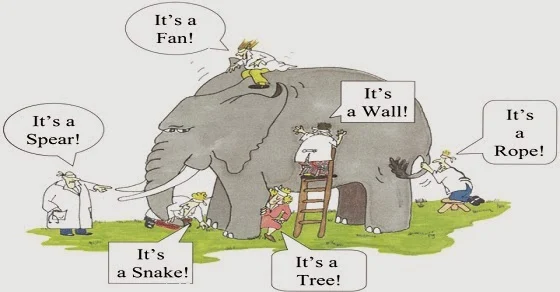
The more I talk to people about what should be included in high school computer science the more I thing of the Indian story of the blind men and the elephant.

blind men and the elephant

I attended an industry advisory meeting for a local career technical school last night. I attend several of these at several schools every year. I hope I provide some value to them from my time in industry and my education experience. I know for sure I get a lot out of these meetings. Industry attendees always have suggestions of what should be included in the curriculum. Usually their suggestions relate to their particular business needs. Hence the elephant story. Computer science is huge as a discipline but the parts we interact with regularly are the parts we think of as important.

When it comes to high school computer science curriculum we do have some standards. The CSTA Standards are really good. In a way though I see them as the floor - the minimum. Even the AP CS courses are not far beyond these standards. They practically read as the AP CS Principles curriculum though one could meet them without the AP CSP course. But what if you want to do more?

The standards are also about concepts and not implementation. That is also great. That is how it should be. It leaves us open to the question of how to implement the teaching of these concepts. This is where the things industry wants us to teach, which is often more about tools than concepts, can be influential. If we want it to be. We don't always want to take those suggestions too far as our students are not ready for everything industry would like us to teach.

What I have been thinking about lately from conversations with industry people are four things:

  • Cloud computing
  • Virtual Reality/Augmented Reality
  • Artificial intelligence
  • Internet of Things

Whoa! That's a lot. And they are all more and more intertwined. It is hard to implement IoT without cloud computing. AI is an important part of VR/AR and the cloud is where a lot of AI is executed. AI, Cloud Computing, and IoT combine for a lot of image recognition. I could go on but if you are a regular reader of this blog you probably know a lot of this.

Which of these is the most important? I think we could get arguments for any of the four as well as various combinations. And while we might like to think we can include a little of each, let’s face it, any of these could be a year long course by itself with bits and pieces of the others to support the main emphasis. So what is a teacher to do? Personally I have totally decided. Actually, just about every day I totally decide on a different one of those four things. Not helpful. Sigh.

Cloud computing looks pretty exciting. Amazon Web Services (AWS) and Microsoft’s Azure both have programs for educators. AWS Educate from Amazon and free Student Azure accounts from Microsoft. Which to choose? I need to spend some serious time looking into both of them I guess. Anyone using either of them in high school want to help me out?

Virtual reality/augmented reality is quite “sexy” and I can see it attracting lots of student interest. David Renton is having his students program VR which is cool. But at $200 a head set funding a classroom set seems daunting.  Still it is cool. And one can teach a lot of concepts to students who are highly motivated to create something awesome.

Where do I start with artificial intelligence?   Microsoft AI School looks like a good place to start learning and using some of their AI tools. OK I’m overwhelmed. I need a face to face course. Somethings are just too much for my old brain.

Internet of Things may be the item that interests me the most. It is a mix of hardware and software and my gut tells me that is as much key to the future of computing as anything. Mix in a little cloud computing for hosting. Perhaps an existing AI took for analysis. Maybe even a little visualization. Not quite VR/AR but interesting non the less. That could be a great course. Now all I need is curriculum or a year of free time to learn it on my own enough to develop curriculum. Sigh (again)

What I’d really like to do is have a class where the students figure all these things out themselves. Have them design and build a major project involving one or more of these technologies while doing the research, experimentation, and learning while I coach. Perhaps connect them with people and documents and videos and the like. Then they can teach me. Now wouldn’t that be great!

Tuesday, June 26, 2018

Facial Recognition, Augmented Reality, and Teaching

Summer is a time of reflection and learning for me. I really want to be a better teacher and summer give me a chance to read more and to think more. This week I have been thinking a lot about facial recognition and augmented reality. One of the things that I know from experience and from research is that knowing students, especially their names, is a powerful thing for a teacher. Faces are hard for me. I don’t know if it is the way my brain is wired (there is a thing called prosopagnosia or face blindness that I would like to blame) or if I am just not working hard enough at it (as my son who knows every student in his elementary school – he’s the principal – suggests) but I would really love augmented reality that would let me know each student’s name.

I also think “wouldn’t if be nice if a computer scanned the class room and took attendance for me?” On the other hand if we take that to a (perhaps) logical conclusion were get computers that track every student’s face to see who is paying attention. They are trying that in China (link below) and that scares me. It especially scares me if it gets tied into a ‘social credit’ ranking system like China is setting up. (Link below or search for China social credit) Oh boy! I can’t see a lot of students liking that one! Below you will find a link to an article about the CEO of a company that develops facial recognition who warns about how ready it is – or is not! Are we really ready to have it judge people? I think I’d rather see people doing the evaluations.

BTW, there are schools experimenting with tracking students with RFID chips. Does using facial recognition take this to a new level or is it just a logical next step? Do we really want to normalize this level of tracking? I’m a little uneasy with the idea. Maybe more than a little.

But to keep this positive and closer to education and making teaching better, Vicki Davis is seeing a lot of artificial reality and augmented reality at the ISTE conference (link to her recent post below) and seeing some positive things. As well as some risks. Could artificial intelligence replace teachers? Maybe the bad ones but what about the good ones? She doesn’t talk about the costs of teachers vs AI though. You and I know that some people would rather have poor to average “teacher” who are inexpensive than spend more money for the best.

I see artificial reality and augmented reality as being very different. Later this week I am getting a demo of the VR system my wife’s school has installed. I may blog about that after. But for now, augmented reality.

Things that lead to more and better interaction between students and teachers is a good thing. Imagine if every teacher in the school could address every student by name the first time they saw them. My gut tells me that is a good thing. Students want to be known and a name is a powerful part of that.

What if a student showed up at my desk and asked me what they got on the recent test? They do that you know. Somehow they think you remember every grade for every one of their students. A AR system could pop that information up for a teacher. That would be good. Right? Potential for abuse? Sure. There is a fine line between deciding to call or not call on a student based on their grades as a good thing or a bad thing. A reminder that a student is on a concussion protocol might be a good thing though.

So both risk and benefit to facial recognition and AR. How we balance that determines if we use it to improve education and learning or just become control freaks who limit student options. Do we use it to build relationships or to hand off everything to computers? Do we use it to share excitement and new ideas or do we just use it to make education inexpensive at the cost of quality?

So much to think about!


Recommended reading

Wednesday, May 24, 2017

Interesting Links 24 May 2017

It’s been a while since I posted one of these collections. And I’ve been blogging a lot less lately. Call it a sort of blogging vacation. I just needed to prioritize other things for a while. We’ll see how things are going forward. In any case I felt like I had a lot of things I should share so here we go.

I know a lot of people are using Python these days and with summer coming you may be looking at projects for next year as I am. So I thought I should share this Collection of free Python lessons (Shakespearean Insult Generator, Magic 8 ball, Sorting hat, Mad Libs, and more) I’ve used similar projects with students in other programming languages and they work well with students.

Announcing Microsoft MakeCode for Circuit Playground Express – From Microsoft Education. The really cool thing about this online development tool is the variety of interesting and inexpensive hardware it can be used with. Combining programming with “making” opens some really interesting possibilities.

Speaking of making – this look at what Doug Bergman is doing with his students is really impressive. A spirited teacher reshapes the computer science classroom for 21st-century makers He has a very interesting computer lab with movable tables, lots of interesting hardware (think several kinds of robots plus Kinects) and really lets students get creative.

Researchers unveil new password meter   - security is getting more and more attention lately so this information about good passwords may be a good discussion starter. The source code for this password meter (it’s in JavaScript) is available.

The ACM Code of Ethics, Draft 2 is now available for comment. Deadline for Input Is June 5th, 2017. This update is designed to make sure that the code is current with the technology. I plan to have some discussions about ethics based around the final document with my AP CS Principles class. I will at least bring it up in the rest of my courses though. Ethics is VERY important and getting more important to teach all the time.

From the UK there is a new edition of Hello World magazine out *now*. Download via   Brought to you by Raspberry Pi, CAS and the BCS Academy. Lots of awesome in this edition. Things are really moving in CS education in the UK and the rest of us should take advantage of the resources.

Check out the Computational Thinking Interview Series from  CSTA “The CSTA's Professional Development Committee is gaining perspectives on computational thinking by meeting with leaders in the field. In this interview series, we are asking, ”What is computational thinking?””

Designing a Computer Science course with constraints  by Mike @zamansky is a good look at how teachers often have to deal with constraints outside of their control when designing a course.

Three Computer Games That Make Assembly Language Fun – They’re not free but they’re not all that expensive either. Some interesting possibilities for some classrooms I think.

Acer Windows Mixed Reality Headset Developer Edition is one of two mixed reality headsets offered by the @MicrosoftStore Available in August when birthday comes. Seeing these inspired a blog post of mine. A post with some ideas and questions I am still looking for feedback on.

Using Virtual Reality for Teaching Computer Science